

Targeted Leads from the US and Europe for an Esoteric Niche (Internal Organ Self-Massage)
A client who presents himself as a shaman-healer from Siberia reached out to us with a wide line of esoteric products. To start, we picked the most neutral one — internal organ self-massage. The niche is banned from advertising, so we worked through an arbitrage approach (backup accounts, warm-up, proxies, antidetect browsers). We started with the US and Canada, and when it turned out leads weren't engaged, we switched the communication channel to WhatsApp, introduced a paid threshold to filter out freeloaders, and moved to Western Europe — the cost per lead dropped.
Read this article in Russian →
A client who presents himself as a shaman-healer from Siberia reached out to us with a wide product line in the esoteric space. There were many products, so the first step was choosing where to start. We decided to begin with internal organ self-massage — this product seemed the most neutral and easiest to promote: it's closer to health and bodywork than to 'pure' esoteric off-topic content, which meant it was easier to get past moderation and easier to explain its value to a cold audience.
Where we started: analytics and strategy
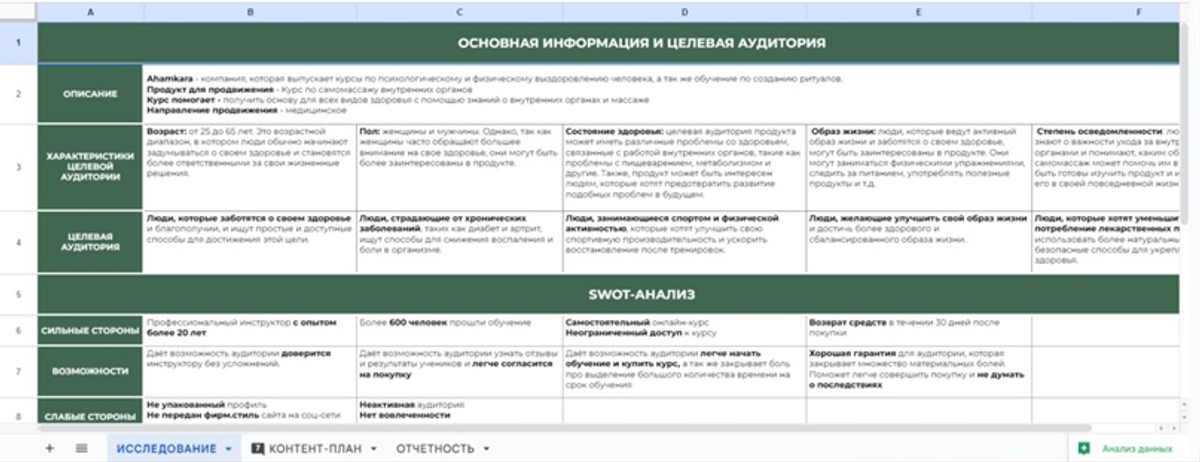
Before launching, we ran a SWOT analysis — laying out the product's strengths and weaknesses, opportunities and risks. For a non-standard niche this is especially important: you need to know in advance what will 'hook' the audience and where the pitfalls are.
The complexity of the niche and an arbitrage approach
Key difficulty: this niche is banned from advertising on the chosen platform (Facebook / Instagram). You can't promote esoteric practices and healing head-on there — accounts get banned for it.
So our approach was technical and built to be as ban-resistant as possible:
- We isolated SMM from targeting — so that if the ad account got banned, we wouldn't lose the client's main Instagram;
- We prepared several backup accounts — so ads wouldn't stall if one got blocked;
- We 'warmed up' accounts before launch — so they’d look natural and raise fewer flags with moderation;
- We used proxies and antidetect browsers for stable operation.
This is a case where results in a difficult niche depend not just on creative, but on technical infrastructure too.
An important constraint: we only handled traffic
To be upfront about the boundaries of our responsibility: we had no influence over the site or the client's further funnel — he turned down those services. What’s more, the site was built on a course platform, and the registration page lived on a different domain — because of this we couldn't even set up analytics on the registration page itself.
In effect, our responsibility was limited to leads and traffic, while everything downstream (follow-up, sales, retention) stayed on the client’s side. We could only offer recommendations.
First attempt: the US and Canada
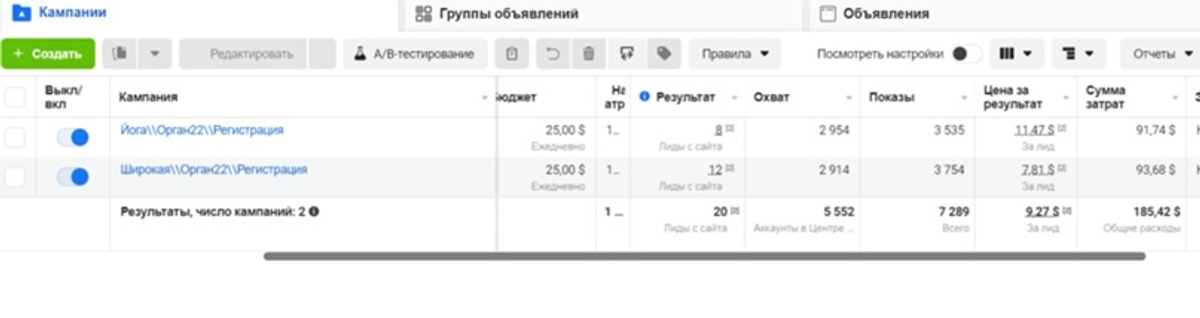
We started driving traffic to the US and Canada, toward a free course.
Results:
- Leads: 28
- Cost per lead: $6.62
- Registrations: 14
- Cost per registration: $13.24

The problem: leads, but no engagement
Feedback came back from the client: users were registering but not active — they'd sign up and not participate.
This is where the most valuable part of the case begins — working on lead quality, not just its price. We dug in and found that the client was reaching out to registrants by email — a weak channel: emails get lost, people don't read them.
What we suggested:
- switch to communicating over WhatsApp — a more personal, live channel with a higher response rate;
- introduce a minimal paywall: €15 for the course and €5 for a consultation, to filter out freeloaders. The logic is simple: a symbolic price removes the casual 'sign up for the freebie' crowd and leaves those who are genuinely interested.
Changing geography: Western Europe
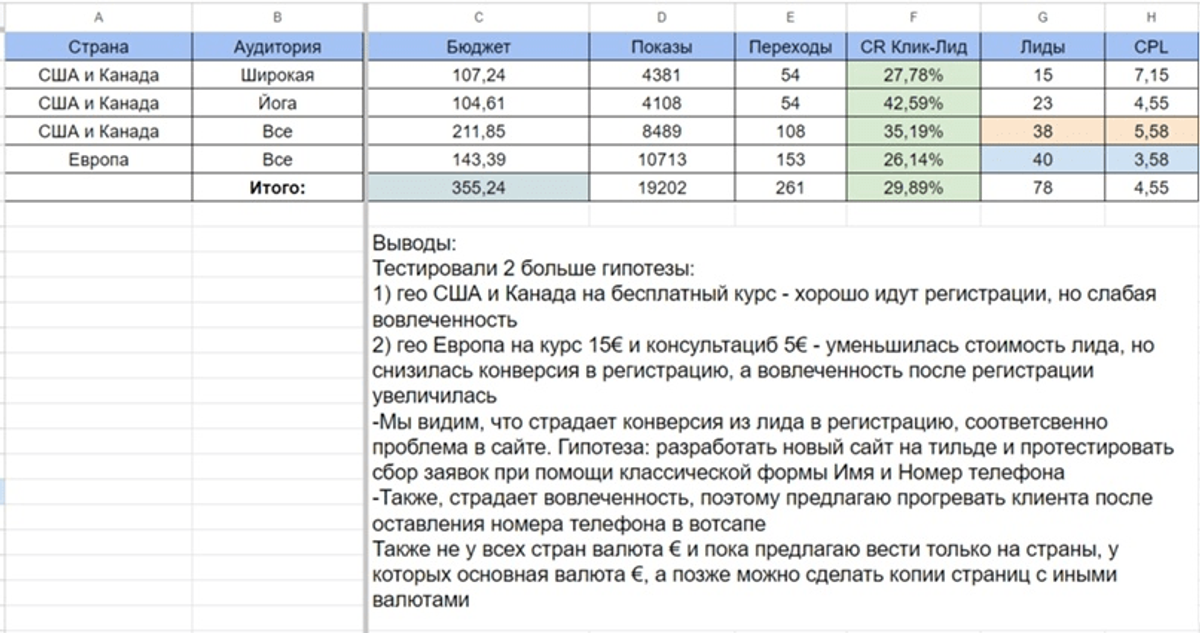
Next we started testing Western Europe, primarily euro-currency countries. And it paid off — cost per lead dropped.
Outcome
Over a month of work, we:
- entered a niche banned from advertising and kept traffic running steadily through an arbitrage approach;
- brought in targeted leads from the US, Canada, and Western Europe;
- through geo testing and funnel recommendations (WhatsApp + a paid threshold), improved lead quality and lowered their cost.
And this despite the fact that we were responsible for traffic alone, with no access to the site or to analytics on the registration page.
Takeaways from this case
- A difficult niche isn't a dead end. Even where advertising is officially banned, you can work through careful technical preparation.
- A cheap lead isn't the same as a good lead. If registrants aren't engaged, you need to change more than the ads — the funnel too: the communication channel and the entry 'filter'.
- Geography strongly affects price and quality. Testing different markets (US → Europe) helped find a more cost-effective audience.
Do you have a non-standard or 'difficult' niche, and people keep telling you it can't be advertised? Message me on Telegram — let’s figure out how to bring in targeted leads even where it seems impossible.
Contact the author
Comments
No comments yet — be the first.