

Why Your Bali Real Estate Ads Stopped Working in 2026. Investors Got Smarter — and That’s Your Problem
How to sell real estate on Bali in 2026, now that ‘20% ROI’ and a sunset pool photo no longer work. A portrait of the new investor, where to get leads for $5, $80, and $200, and why an expensive lead often pays off faster than a cheap one. A breakdown with numbers, unit economics, and no fairy tales about paradise.
Read this article in Russian →
Remember that lovely time when selling a ‘dream investment villa’ just took three ingredients? A photo of the pool at sunset 🌅, a promise of ‘20% ROI’ 📈, and a Canggu geotag 📍. Leads flowed like a river, and the ad budget paid for itself before it even got charged to the card))
Well. That party's over(
My name is Darina Ledin. I've been working in Indonesian real estate since 2023.
2026 on Bali is no longer about pretty rice fields in your Instagram feed. It’s about the dry math of KKPR zoning and being able to explain to a client why the tax is 12% and the management company’s commission is 20%. And if you’re still selling real estate like a postcard, I’ve got news for you: you’re not building a business, you’re sponsoring Meta’s ad auction 🤡💸
I'm ready to tell you where your ad money is really leaking. Why a $4.8 CPL can turn out to be a loss, while an $80 lead from Google can be gold. And how one video with a lawyer talking about permits sells better than a hundred ‘life in paradise’ videos
Spoiler:
in 2026, on Bali, the winner isn't the one with the fattest ad budget — it's the one who answers WhatsApp faster and has cleaner paperwork on the property. Let's break down how to stop burning your deposit on pretty ads and start selling like a grown-up.
What's in this article:
1 Investor portrait 2026: why the client no longer believes in ‘guaranteed 20%’ and demands screenshots of payouts from the management company’s dashboard
2 FB VS Google VS LinkedIn: where to get leads for $5, where for $80, and where for $200 — and why an expensive lead often pays off faster than a cheap one
3 A funnel that works: how a chatbot does the work of a whole sales department in 5 minutes, and why without a construction-site video tour you’re just white noise
4 Unit economics: what it actually costs to bring an investor to a deal in the $100k–$500k+ segments
5 Key insights: why Uluwatu is eating Canggu’s budget for breakfast, and how one video about a PBG permit converts better than 50 Reels about a ‘paradise island’
Investor portrait 2026: who’s buying real estate on Bali today and why they no longer believe the fairy tales 🕵♀️💰
If you still think your client is some abstract ‘rich guy from Moscow or Sydney who wants a little house by the ocean’ — I’ve got bad news. In 2026, that guy got smarter, got himself a spreadsheet, and now wants not pretty sunsets but an OSS extract with the plot’s zoning 🫠
Let’s go through it step by step. Who these people are, what they want, and how to talk to them now in the language of advertising.
Geography: where the money’s coming from 💸
The Bali market in 2026 is no longer a ‘Russian village in the tropics’ — it’s a full-blown international melting pot. Remember 2023–2024? When the whole Canggu district got jokingly renamed on Google Maps to “New Moscow” — so much so that Indonesian ministries had to issue statements about it 😅 Billboards in Russian hung around the island: “You cannot work on a tourist visa. Respect Indonesia’s laws.” Locals nicknamed the PARQ Ubud complex “little Moscow” — relocants lived there in tight clusters and, let’s be honest, didn’t always play by local rules.
It’s different now. The Russian-speaking segment hasn’t gone anywhere — it’s still one of the most active and well-funded. But the market has stopped being a ‘closed club for insiders.’ Today on Bali, Australians, Europeans on Second Home Visas, Chinese and Singaporean buyers, plus Indonesian high-net-worth locals are all competing for the best properties. Competition is global, and investors compare Bali not to neighboring Ubud, but to Dubai, Cyprus, and Thailand.
Here’s how demand is currently split across the key regions:
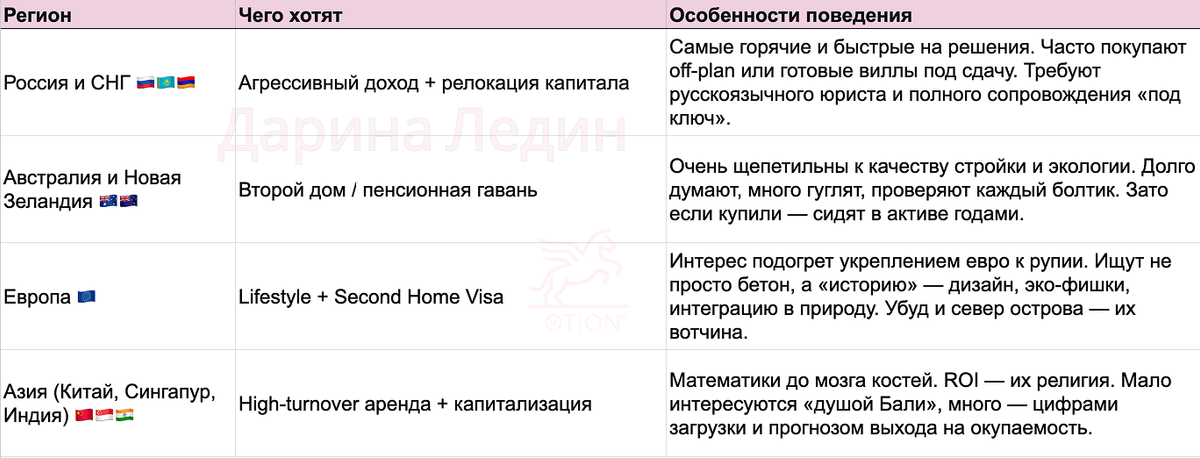
Takeaway for advertising: One creative for everyone doesn’t work anymore. For Australians, show certifications and eco-materials. For Russians, an ROI calculation in hard currency. For Chinese buyers, an ADR and occupancy chart for the past 12 months
Motivation: why they’re even here 🤔
In 2026, investor motivation has split into three clear tracks. ‘Just buy a villa on Bali’ is no longer an argument. People want to understand exactly what problem they’re solving.
Track 1. Passive income (but now — an honest one)
It used to work to write ‘20% ROI’ — and people bought it. Today that gets you laughed at or flagged as a red flag 🚩 The modern investor wants to see Net ROI. That means:
- Minus 12% tax
- Minus 20–25% management company commission
- Minus operating costs
- And only then — their net profit
If you’re not ready to show a screenshot from the management company’s dashboard with real payouts from last year, you lose trust on the second touchpoint.
Track 2. Relocation and Second Home Visa
Buying property on Bali in 2026 isn’t just about money — it’s about a ‘residency ticket.’ With a purchase of $130k+, an investor qualifies for a Second Home Visa (up to 10 years). That’s a massive trigger for Europeans and Russians who want to legally winter somewhere warm. In advertising, this works as ‘you’re not just buying a villa, you’re buying the right to live on the island.’
Track 3. Speculation (its market share has dropped sharply)
There are far fewer people now buying with the goal of ‘sell it for more in a year.’ The market has stabilized, the median price has settled, and the gap between listing price and deal price has shrunk to a minimum. The fast money is gone. And thank god — fewer bubbles 🤷♀️
Behavior: how they make decisions (spoiler: slowly and tediously) ⏳
If back in 2023 a client could see a Reel, DM you, and put down a deposit within a week, it’s different now. The deal cycle has stretched to 12–15 touchpoints 😵💫
Here’s what a typical investor journey looks like in 2026:
- Touches 1–3: saw the ad → scrolled the profile → left to think it over.
- Touches 4–6: came back a couple weeks later → went to Google to search ‘zoning for [this district]’ and ‘reviews of the developer.’
- Touches 7–9: subscribed to an expert’s Telegram channel → spent a month reading breakdowns on PBG, SLF, and taxes.
- Touches 10–12: messaged on WhatsApp with a specific question: ‘Can you show me the land lease agreement.’
- Touches 13–15: requested an online viewing or flew to the island.
What does that mean for us? If you don’t have a nurture system, you lose the lead somewhere around touch 3–5. They simply move on to the broker who methodically feeds them useful content and doesn’t let them forget about him 🤓
What changed in the investor’s head: three major shifts 🧠
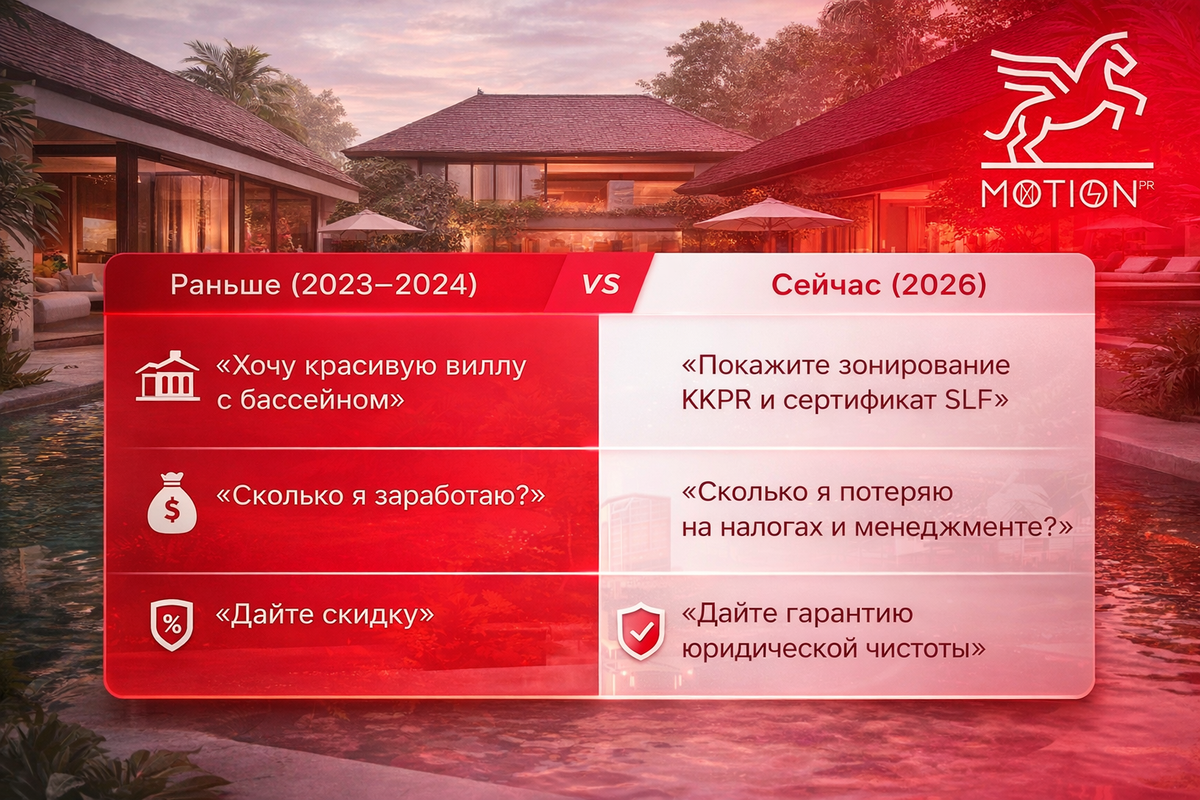
The 2026 investor has stopped being a tourist with money. He’s become an entrepreneur buying an asset in a foreign jurisdiction. And he approaches it with matching paranoia 🔐
Summary for your ad strategy 📌
To avoid pouring your budget into the void, remember three rules:
- Segment by geography. For Russians — yield and support. For Australians — quality and legality. For Europeans — the visa and design.
- Speak the language of numbers. Net ROI, ADR, Occupancy, taxes. Emotion only works paired with numbers.
- Prepare for a long cycle. Without a chatbot, newsletters, and regular content, you’re just warming up the audience for your competitors.
FB VS Google VS LinkedIn: where to get leads for $5, where for $80, and where for $200 — and why an expensive lead often pays off faster than a cheap one
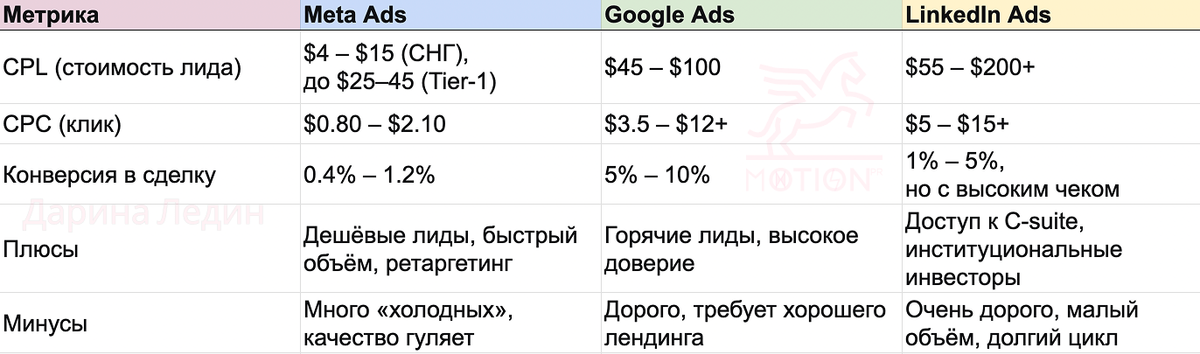
The most common question I hear from people entering the Bali market: ‘Where do I put the budget? FB or Google?’ 99% of the time I answer: “Depends what you’re going to do with that lead afterward”.
Let’s break it down:
The fundamental difference: why people even open these apps
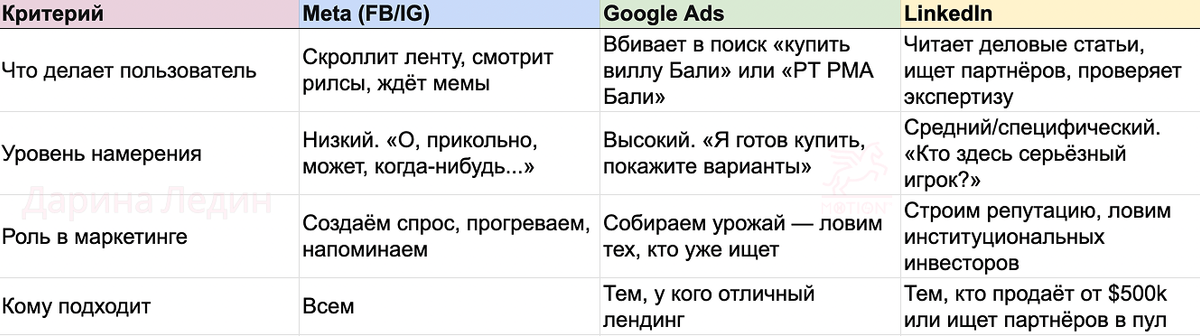
Comparing the metrics: what things cost on Bali in 2026
LinkedIn: the dark horse everyone forgets about
Honestly, the first time I heard about LinkedIn for selling villas on Bali, I rolled my eyes. Who’s even there? IT people, HRs, consultants... What real estate?
And then someone showed me the actual case studies))
When LinkedIn actually works:
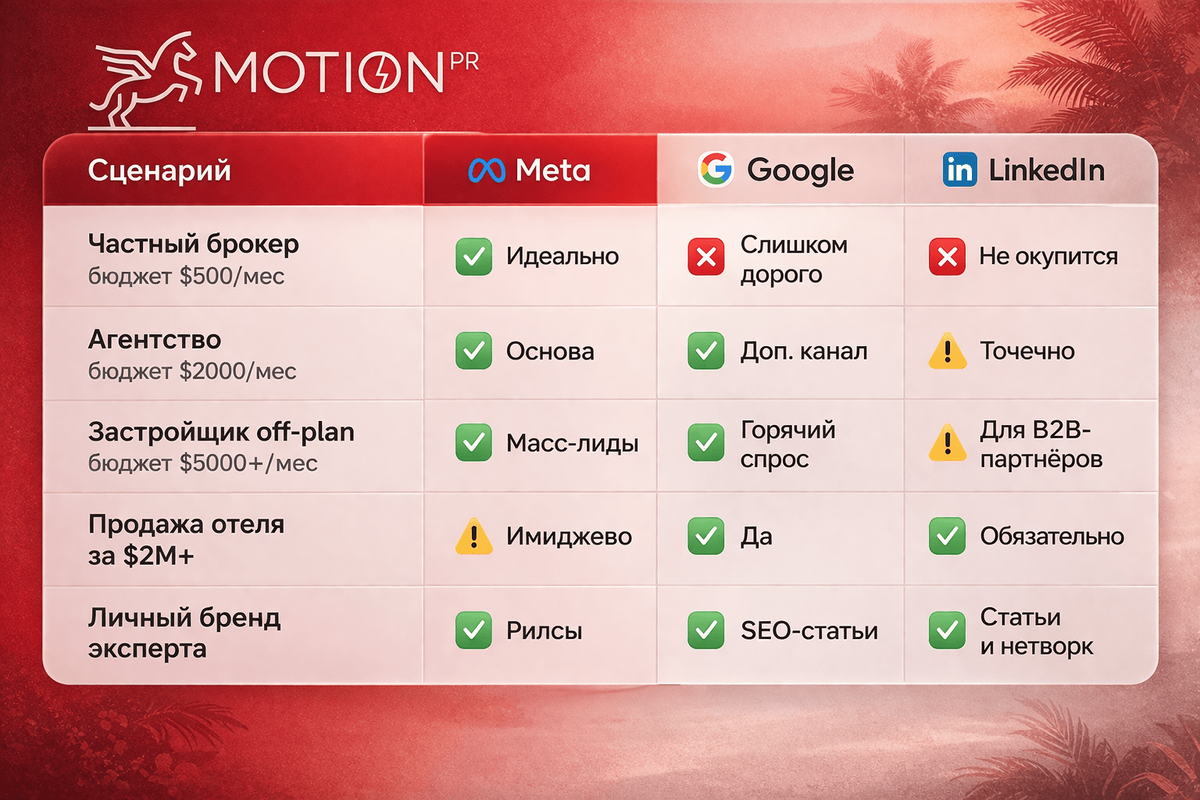
- You’re selling commercial real estate (hotels, guesthouses, coworkings)
- You’ve got a $500k+ property and you’re looking not for a retail investor but a partner for a pool
- You’re raising money for development projects and need not individuals but companies and family offices
- You’re building a personal expert brand and want to be found for ‘Bali real estate investment advisor’
Numbers worth knowing:
- Average CPL on LinkedIn for the B2B segment in Indonesia ≈ $50–770
- But! One such lead can bring in a $2M+ deal
- Document Ads work great on LinkedIn — where someone downloads your investment memorandum right in the feed
- Thought Leadership Ads (boosted expert posts) give the warmest contact
A combo that worked for me on LinkedIn: a breakdown post: “How I checked the zoning on a plot in Uluwatu and saved a client $300k”. We boosted it via LinkedIn Ads to the ‘Real Estate Investors Southeast Asia’ audience. Leads DM’d me themselves saying: ‘This looks expert-level, let’s talk.’
Is CPL high? Yes. But CAC (cost per deal) is one of the lowest in the premium segment. And the auction isn’t overheated!!!!!
Comparison table by use case
How to make them work together: the ideal multichannel combo 🤝
The smartest players on Bali in 2026 don’t pick one channel — they build an ecosystem:
- Meta (top of funnel): run Reels and carousels. Goal — introduce yourself, collect subscribers on Telegram/WhatsApp, nurture them.
- Google (bottom of funnel): catch those who’ve already seen the Reels and gone to Google ‘villa Bali price’ or your project’s name.
- LinkedIn (parallel track): for the premium segment and partnerships. One expert post a week. One Document Ads push a month with an investment memorandum.
The result of this combo:
- Meta gives you volume and keeps you top of mind
- Google captures hot demand
- LinkedIn brings in the ‘whales’ that pay for everything else
Don’t chase a cheap CPL at the expense of quality. Meta gives you volume, Google gives you depth, LinkedIn gives you status and access to big tickets. Perfect 2026 marketing isn’t choosing one channel — it’s knowing how to conduct an orchestra of three instruments.
A funnel that works: how a chatbot does the work of a whole sales department in 5 minutes, and why without a construction-site video tour you’re just white noise
The most annoying thing: nail your targeting, get great leads, and... flush them down the toilet because your manager replied 4 hours later 🫠
If you’re still working the ‘collected the lead → called the next day’ way, you’re warming up the audience for your competitors. In 2026, response speed isn’t a ‘nice bonus’ — it’s the only way to stay in the game.
Why speed decides everything (and what’s with the 5 minutes)
Stats from my own cases:
- If you reply to a lead within 5 minutes, conversion to qualification is 9x higher than replying within an hour
- 83% of clicks from Meta come from mobile devices
- If the form takes longer than 2.5 seconds to load, CPL jumps 1.5–2x
Does your manager reply within 5 minutes? At one in the morning Bali time? When a lead from Moscow or Sydney fills out the form?
Model 1. Real estate agency: a flow funnel with a quiz
Meta Ads (Reels with an offer) → Quiz ‘Find your perfect Bali neighborhood in 2 minutes’ → WhatsApp chatbot → Qualification → Property shortlist → In-person viewing
What happens after the click:
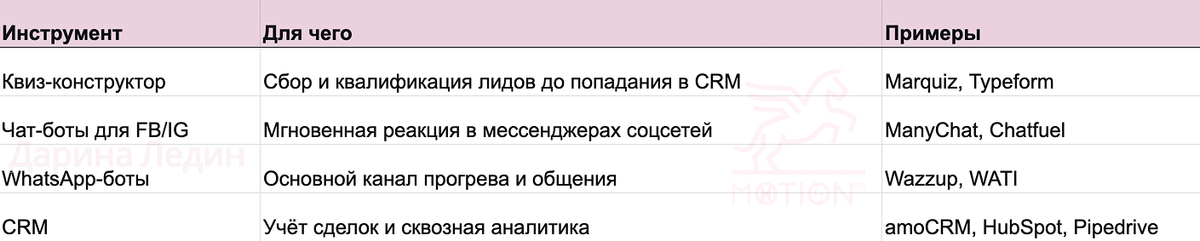
- The lead lands on the quiz (a landing page or right inside the chatbot). Simple questions: budget? goal? citizenship? preferred area?
- Right after the quiz, the chatbot sends a WhatsApp message: ‘Thanks, Ivan! I’ve found 3 villas that match your request. Want to take a look?’
- If the budget is above a certain threshold (say, $150k), the bot automatically offers to book a call with an expert.
- Then it’s manual work for the manager — but with a warm lead who’s already answered the questions himself.
Why it works:
- The lead doesn’t wait for a reply — they get one instantly
- You save hours of your manager’s time on initial qualification
- You collect structured data in your CRM instead of scattered WhatsApp messages
Tools:
Model 2. Promoting a specific property: a scarcity funnel
Meta/Google Ads → Property landing page with a 360° video tour → ROI calculator → Unit reservation request → Manager → Deal
The tricks that actually move the needle on conversion:
- A construction-site video tour. Not renders, not pretty pictures from Pinterest, but real GoPro footage: ‘Here’s what your future home looks like today. Here’s the foundation, here’s the walls, here’s the view from the window.’ According to Arfadia, a virtual tour boosts inquiries by 20–35%.
- Scarcity with proof. Not just ‘only 3 villas left,’ but a CRM integration: ‘Booked: 17 of 20 units. Last booking — yesterday.’ People trust numbers, not generic phrases.
- An ROI calculator. Right on the landing page: pick a villa type → see the income forecast, occupancy, payback period. The 2026 investor wants to play with the numbers himself.
A real example: a developer in Uluwatu launched this kind of funnel for a new complex of 12 villas. Budget $2,500/month. Result: 8 deposit bookings in 6 weeks, CPL $11, lead-to-booking conversion ~4%. Of those 8 bookings, 6 have already closed into deals, 2 are still in paperwork.
Model 3. Broker’s personal brand: a content funnel
YouTube / Instagram / Telegram (expert content) → Follow → Nurture (case studies, breakdowns, insights) → DM → Deal
What works in 2026 content:
- Legal breakdowns. A video like ‘How to check a plot’s zoning in 3 minutes’ or ‘Why a PBG matters more than a pretty render.’ This is what investors actually worry about.
- Neighborhood breakdowns. ‘Why Uluwatu is beating Canggu in 2026’ — converts 2.8x better than generic ‘top 5 villas on Bali’ roundups.
- Real numbers. Screenshots of management-company payouts, Net ROI calculations, case studies with real names (with clients’ permission).
Why it pays off:
- CPL via a personal brand is the lowest over time (essentially zero if you only count ad spend)
- Trust conversion runs up to 25–30% (the lead arrives already ‘warmed up’)
- Deals close faster and with fewer objections
Downside: it’s slow. The first 3–6 months you’re just planting content and growing an audience. But after that, it runs like a perpetual motion machine.
My case
I ran a launch for a developer in Uluwatu — a new complex of 14 villas, priced $180–220k. The task: build a pool of prospective investors ahead of the sales launch.
What we did:
- Launched Meta Ads targeting the Russian-speaking audience (CIS + Russians in Europe and Asia)
- Offer: ‘Passive rental income from villas on Bali — a clean 12–15% a year’
- Creatives: short Reels walking through the construction site + a carousel infographic ‘bank deposit vs. a villa on Bali’
- Funnel: a Marquiz quiz (‘Which villa suits you?’) → WhatsApp chatbot → automatic budget qualification → booking a call with an expert
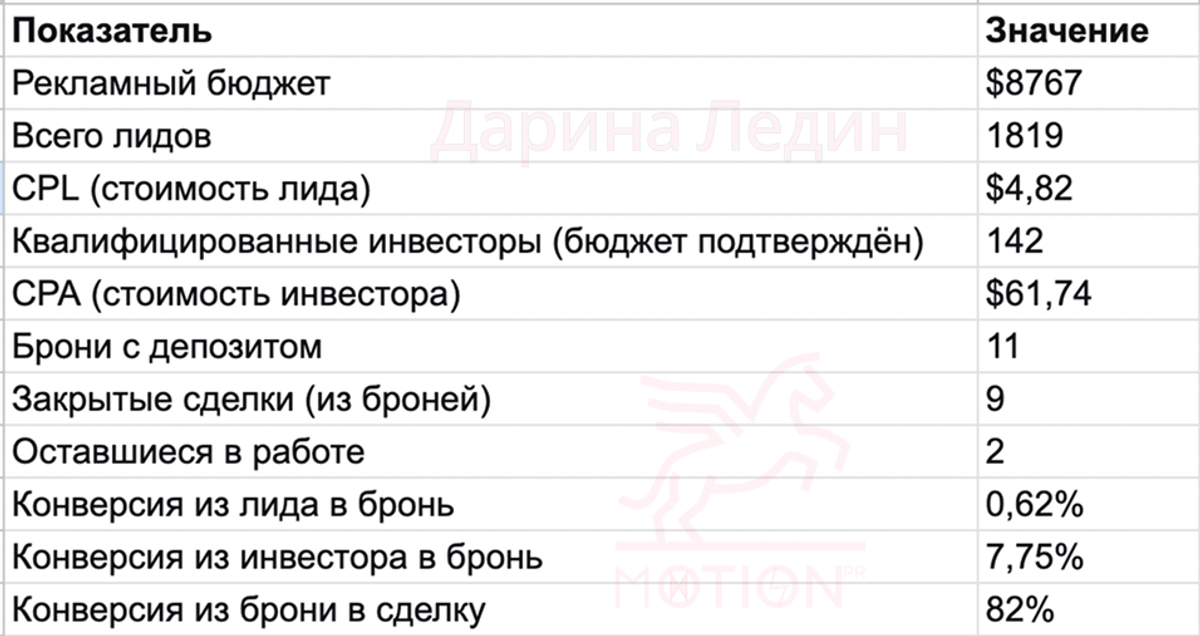
Numbers for the first 3 months:
What worked best:
- Instant chatbot response. 90% of leads got their first WhatsApp message within 30 seconds of completing the quiz. No manager can reply that fast, especially given the time difference with Moscow and Europe
- Automatic segmentation. The chatbot immediately filtered out anyone with a budget under $80k and offered them a Telegram channel with free market materials instead. Managers only worked with warm leads — a massive save on time and sanity
- Construction footage, not renders. 2026 investors want to see real progress, not pretty designer pictures. One Reel of a hard-hat walkthrough of the site brought CPL 30% lower than a carousel of 3D visualizations
- Retargeting people who didn’t finish the quiz. About 20% of bookings came straight from retargeting — people needed 2–3 more touches before they were ready to fill out the form.
Main takeaway: a low CPL is great, but the real magic happens at the qualification stage. Out of 1,882 leads, only 142 turned out to be paying-capable investors. If we’d processed that entire flow by hand, we’d have had to hire three managers and still lost applications. The chatbot and the quiz did the work of a whole sales department for $60 a month.
ROMI (return on marketing): with an average ticket of $200k and 9 closed deals, turnover came to $1.8M. Against $8,500 in ad spend — that’s a 210x+ return on the marketing budget invested. Even accounting for agency commission and manager salaries, the math is more than pleasant)))
Breakdown by source within Meta
Instagram Reels — the absolute champion. More than half of all leads came from here, and at the lowest CPL — around $3.8 apiece. Meta’s 2026 algorithm just loves Reels and pushes them into recommendations for free. A 15-second clip — ‘here’s the construction, here are the yield numbers’ — and the lead is yours.
Instagram Stories — in second place. CPL is a bit higher, around $5, but the audience there is the warmest. Mostly people who’d already seen our account or started the quiz and got distracted. Retargeting through Stories is a must-have.
Facebook Feed — expensive, but rich. Fewer leads came from there, CPL under $6.3, but this exact channel brought two investors who ended up buying villas. That’s where the 40+ crowd lives — people with real money who want to put it into concrete, not crypto.
Facebook Reels — a dark horse. Not many leads, but one deposit booking came from there. Worth keeping in your tests if budget allows.
Instagram Feed — RIP. Static feed posts in 2026 only work for image-building. CPL under $9.5 and barely any applications. If you’re still pouring budget there, you’re not selling — you’re just existing prettily.
Conclusion: want it cheap and plentiful — do Reels. Want quality — don’t skip Facebook Feed. And leave static Instagram feed posts to lifestyle bloggers; investors don’t live there 🙃
Unit economics: what it actually costs to bring an investor to a deal in 2026
Now for the part everyone forgets about until the money on the card runs out. A $4.82 CPL looks great, but it’s only the tip of the iceberg.
CPL — the tip of the iceberg. Over 3 months we spent $8,767 on ads and got 1,819 leads. CPL — $4.82. Nice to look at, but it’s too early to pop the champagne 🍾
CPQL — cost per qualified lead. Of all those applications, only 142 people made it through the chatbot’s filter and confirmed their budget. The rest were ‘just looking,’ ‘is there anything cheaper,’ ‘I thought this was a rental.’ Divide $8,767 by 142 — you get $61.74 per real candidate.
CPA — cost per booking. Of the 142 qualified investors, 11 put down a deposit. The rest went off to think, compare, consult with spouses and lawyers. Divide the budget by 11 — and now it’s $797 per booking.
CAC — cost per deal. Of the 11 bookings, 9 closed. Two are still in paperwork — documents, banks, Bali’s unhurried pace. Final cost of acquiring one buyer — $974.
Average ticket on the project — $200,000. Divide $974 by $200,000 and multiply by 100% — you get 0.49%. In real estate, a CAC of up to 2–3% of the property’s price is considered acceptable. Ours is under half a percent. On an $8,767 budget, we brought the developer $1.8M in deals. ROMI — over 200x 🔥
Here’s where people usually lose money. First — they only look at CPL and celebrate without counting how many of those leads actually made it to a deal. Second — they forget about manager time. In my case, a $50/month chatbot filtered out 92% of the noise and saved at least a couple thousand dollars in salaries. Third — they expect instant payback, even though the deal cycle on Bali runs two to six months.
5 key insights of the 2026 market: why Uluwatu is eating Canggu’s budget for breakfast, and how one video about a PBG permit converts better than 50 Reels about a ‘paradise island’
Insight 1. Uluwatu is the new king, and Canggu has fizzled out 👑
If in 2023-2024 everyone worshipped Canggu and was ready to take a 20%-a-year loan for ‘a promising plot in the heart of the scene,’ by 2026 the smart money flowed south. Here’s why.
Canggu has hit saturation. According to Q1 2026 analytics, median-price growth there has practically stopped — just +1.1% quarter over quarter. Meanwhile, land in Uluwatu is still 40% cheaper than in comparable tourist zones of Canggu, even though nightly rental rates there are the same, if not higher.
What that means for us as marketers:
- CPM in the Meta auction for the ‘Canggu luxury villas’ audience rose 1.5x over the past year — it’s just crowded there
- Meanwhile, creatives geotagged Uluwatu / Bingin get a 20–25% cheaper click and better lead conversion
- 2026 investors are looking for growth potential, not a ‘stable but overheated market’
My personal takeaway: if you’re still pouring your whole budget into Canggu, you’re sponsoring someone else’s auction. Uluwatu gives you the same premium segment, but with less competition and a hungrier audience.
Insight 2. Compliance content converts far better than lifestyle content
In 2026, exactly what I was talking about at the start happened: regulatory cleanup became the main selling point. And it’s not just talk — the numbers back it up.
Starting March 31, 2026, platforms like Airbnb and Booking began forced syncing with OSS (Indonesia’s licensing system). Villas without a verified NIB and the right KBLI simply disappear from search.
What this means for marketing:
- The 2026 investor is terrified of buying a ‘grey’ property they won’t be able to legally rent out afterward
- Creatives with headlines like ‘We checked the KKPR zoning for you,’ ‘PBG and SLF included,’ ‘Not a green zone — verified’ get 1.8–2.5x higher CTR than the classic ‘dream villa with ocean views’
- One video breaking down a specific property’s paperwork brought me more qualified leads than 50 Reels of pretty sunsets
The insight is simple: in 2026, ‘pretty’ doesn’t sell anymore. ‘Safe and legal’ sells. And whoever figures out first how to package legal cleanliness into a creative skims the cream off the top
Insight 3. ‘Structure’ is the new luxury, not marble and panoramic windows
Premium used to be defined simply on Bali: marble floors, floor-to-ceiling glass, designer furniture, and an ocean view. By 2026, that set has become the baseline — everyone has it.
The new luxury is invisible luxury: a transparent legal structure, a clear tax model, and operational readiness for management.
How this shows up in advertising:
- A ‘15% yield’ offer no longer works without a breakdown: minus 12% tax, minus management commission, minus operating costs. Investors want to see Net ROI, and if you don’t show it, you lose trust on the second touchpoint
- Properties where the developer offers not just a villa but a ‘turnkey package’ with a PT PMA, KBLI, and a management contract sell at a 15–20% premium to market
- Visuals with an ‘ownership structure’ infographic convert better than 3D interior renders
Insight 4. The market has split: ‘quality scarcity’ vs. ‘generic oversupply’
In 2026, a unique situation has formed on Bali that I call bifurcation. There are two parallel markets, and they live by different rules.
Market A — quality scarcity. Legal properties in tourist zones with a full set of documents. There are few of them, demand is huge, prices are rising, and ads pay off fast.
Market B — generic oversupply. Thousands of identical ‘white boxes,’ built in green zones or with violations. Their owners are dumping prices, trying to sell the assets somehow.
What this means for promotion:
- If you’re promoting properties from Market B, brace for a CPL 2–3x higher and a deal conversion near zero. Investors have learned to check the paperwork before the very first touchpoint
- If your property is from Market A, you’re sitting on a goldmine. Just show the documents, the zoning, and the structure — and leads will come in at $4–5 with above-market conversion
- Important: always highlight ‘verified legality’ in your ads. That’s not a downside — it’s your main USP in 2026
Insight 5. The 2026 investor is a paranoid person with a calculator. And that’s a good thing
The last, but maybe the most important, insight. The investor’s profile has changed radically.
Before: saw a pretty picture → DM’d → put down a deposit within a week. Emotion ruled.
Now: 12–15 touchpoints, a spreadsheet with a Net ROI calculation, a request for screenshots of payouts from the management company, an independent lawyer checking the zoning, a call to ‘a friend who already bought on Bali.’
How to adapt your marketing to this:
- A quiz instead of a lead form. The 2026 investor wants to ‘play’ with the numbers himself. An ROI calculator on the landing page is a must-have
- A construction-site video tour instead of renders. People are tired of pretty pictures that have nothing to do with reality. A GoPro in a foreman’s hands sells better than a $5,000 3D visualization
- Transparency bordering on paranoia. Show the land lease agreement, the payment structure, case studies with real yield numbers (not forecasts). The 2026 investor is willing to pay a premium for honesty
Bonus insight: a WhatsApp bot is your best employee 🤖
I already mentioned this in the funnel section, but it’s worth repeating because it matters. In 2026, response speed = conversion. A lead who gets a reply in the first 5 minutes converts to qualification 9x better than one who waits an hour.
A $50/month chatbot does the work you used to need 2–3 managers for. It doesn’t sleep, doesn’t take a vacation to Nusa Penida, and never forgets to ask about budget. If you still don’t have one, you’re losing at least 30% of potential deals simply because you ‘didn’t get around to replying in time.’
The bottom line
Bali in 2026 is a market for people who can do math, check documents, and reply on WhatsApp faster than the competition. Pretty pictures don’t sell anymore — transparency sells, Reels with numbers sell, and a $50 chatbot sells. If you’ve read this far, you’re already in the minority that actually wants to close deals, not just collect leads. Let’s work 🤙
Contact the author
Comments
No comments yet — be the first.